Archive for October, 2000

Interview with a Shop Owner

Monday, October 30th, 2000

It always amazes me when I go out with a group of friends and we end up spending more on a meal in a nice restaurant than many Thai people make in a month. I recently spent an afternoon talking with a Thai shop owner about how he gets and spends his money and about his country.

Mr. C lives in the eastern part of Bangkok in a relatively non-descript residential neighbourhood. He is a friendly, open, and mellow guy. His townhouse looks like most of the others. The front of the house, which would usually be used as a covered parking area, has been converted into a small shop.

The shop sells basic necessities such as soft drinks, snacks, beer, soda, cigarettes, cleaning products, and canned and bottled groceries. Entering into the house through the shop there is first a large living room and dining area, a long narrow kitchen in the back, and one bathroom. Upstairs there are two modest-sized bedrooms and one more bathroom. The total living space is about 76 square metres.301000k1.jpg Both he and his wife work in the store.

Mr. C is married and is about 50 years of age. His wife, daughter (age 19), and niece (age 22) live with him. Both his daughter and niece are students. He earns about 40,000 baht/1,000 US dollars a month, which is well above average in Thailand.

The United Nations Statistics Division figures in 1998 showed an average annual income for Thailand of 1,890 US dollar. This is 6,300 baht or US$157.50 per month. Mr. C is doing well.

Mr. C owns three telephones, two television sets, two stereos, four radios, two video cameras, two video players, one motorbike, and two automobiles.

He owns his own house. He spends 12,000 baht (300 US dollars) a month on food and 1-2,000 baht (25-50 US dollars) a month on electricity because he does not use air-conditioning. He spends 800 baht (20 US dollars) a month on transportation. This is a low figure but Mr. C is a homebody and does not like to travel much. He earns about 3,000 baht (75301000k2.jpg US dollars) a month from his small store. The logical question is where does the other 37,000 baht come from? The answer is an interesting one.

Mr. C worked in Bangkok for 12 years and saved his money. He bought some land in Rayong, which is on central eastern coast of Thailand. One 20 rai (8 acre) lot of land cost him 70,000 baht (1,750 US dollars) and the other 20 rai lot cost him 50,000 baht (1,250 US dollars). The family lived in Rayong until one day when they were robbed. They decided to return to Bangkok and sold the two lots for a total of 400,000 baht (10,000 US dollars), giving them a nice 280,000 baht (7,000 US dollar) profit.

Ironically, one of the lots Mr. C used to own recently sold for 35 million baht (875,000 US dollars). The town of Rayong has become as bustling seaside community for vacationers and tourists.

Upon returning to Bangkok, Mr. C bought his house for 330,000 bath (8,250 US dollars). He then subdived the house into two smaller301000k3.jpg townhouses, selling one for 380,000 baht (9,500 US dollars). Mr. C has purchased and rented out a handful of other apartments in his area. He has also lent money to his brother through the years and receives interest due on this loan.

His dream for the future is to own a Ferrari F40 and his most prized possession is his 25 year old red Mitsubishi GTO. When asked what he thinks the biggest problem facing his country is he replied, “Thai people follow foreign ways too much these days. They are too ready to accept Western values without even questioning them. We are told very often that being Thai is not good and that anything from the West is cool.”

As an example he mentioned a recent radio commercial for a psychic hotline that tells Thais to stop believing in their old superstitions. The commercial sites the belief that when a lizard makes a clicking sound when you leave your house it means bad luck. The commercial says this is nonsense, and that instead one should rely on their modern hotline to get real information. The motto of the advertisement is ‘out with the old and in with the new.’

When asked how he views foreigners living in Thailand (called ‘Farang’ in Thai) he stated, “They tend to look at Thais as employees and as being stupid. They are not interested in Thais or in Thailand. They are selfish and always think of themselves first.”

When I asked him how a Thai is different he answered, “Thais are more ready to help each other and have more of a sense of community. Foreigners tend to have a ‘you do something good for me and then I will do something good for you’ one on one sense of helping.”

Mr. C said when he was a child he was always very excited to see foreigners. Now he thinks foreigners are not that much better than he is. When asked about other thoughts on foreigners Mr. C. said, “Thais always take the slow road and foreigners always take the expressway.”

Checking Out Bangkok’s Canals

Monday, October 23rd, 2000

Not only in Venice can you spend a wonderful afternoon exploring a canal. If you chose to explore a canal in Bangkok you will not be in a gondola. You will most likely be in a long-tailed boat with a rather loud and funny looking engine with a long-reaching propeller attached to it. You will be exploring what is called a khlong.

‘Khlong’ means road in the Mon language. Mon people were the first Indian-influenced civilization to arrive in Asia. If you think about how important roads are now, you can imagine how important khlongs were then. There is still a khlong called Khlong Mon in Bangkok.

Khlongs used to play a vital role in the daily life of the city. The Chao Phraya River provided the water needed for these great networks of transportation. The majority of Bangkok’s population once lived along its khlongs and riverbanks. Raft houses were popular accommodation and houses built on stilts along the water’s edge gave easy access to bathing, cooking and drinking water,231000k1.jpg and a variety of shopping and dining options, which simply came paddling by the front door. Khlongs were the super-highways of Bangkok until the age of the automobile arrived.

As automobiles took over the city, many of the khlongs were filled in and made into roads. This is said to have contributed greatly to the increase of the temperature within the city because the cooling effects of this water and the surrounding greenery were greatly reduced. Don’t worry. Khlongs have not been totally eliminated and river life is still alive and well within Bangkok.

The floating markets that make their way through Bangkok’s waterways are one of the major tourist attractions the city offers. Highly publicized photographs of vendors with their boats piled high with fruits and vegetables in swirling arrays of colour make these markets highly sought after photo opportunities by visitors. In my opinion, any khlong is a good khlong. There is a world of wonder waiting on any waterway you231000k2.jpg chose to wander down.

Exploring a khlong is a wonderful way to get the inside scoop on daily life in Thailand. Khlong travel gives you a chance to look into people’s backyards, marvel at the whole other world of river life within the city, and provides a break from the traffic jams and automobiles that pack the city. Khlong travel also allows a magnificent glimpse into the past.

I recently took a khlong journey with an old man nicknamed Uncle Clean near Suhkumvit Soi 77 in Bangkok. Smiling faces, waving hands, engine smoke, and the smell of pollution filled the air as our boat vroomed and chugged away from the pier.

I enjoyed seeing many children splashing and jumping into the water. I watched people fishing, vendors selling noodle soup, fish, and grilled meats from their very small boats, and women doing their laundry. I peered into little shops and stalls set up along the banks. Older and larger rice barges and canoes went by. Other long-tailed boats were busy231000k3.jpg carrying propane gas tanks, large jugs of water, beer kegs, or other people to their correct destinations. People were strolling along the banks, eating in a variety of restaurants along the way, chatting, feeding fish, and watching and waving at us as we passed by. What a relaxing afternoon!

There is a down side to khlong exploration. Many khlongs in Bangkok are massively polluted. Bad smells and dead fish joined the experience. I watched people bathing, brushing their teeth, and drinking the water. Massive piles of rubbish filled the banks and stray trash went floating by. Well, this is also part of the experience and is a good reminder not to litter.

I also spotted some khlong divers at work along the way. Khlong divers dredge on the bottom of the canals in hopes of finding long-lost treasure. They pull up buckets of sludge and sift through it.

Eventually these khlong divers make their way onto the streets of Bangkok to sell the treasures that they have found. If you see a street vendor with big tubs of slime covered coins and other muddy objects on display, chances are you have run into one of these divers.

You have to be prepared to get quite dirty if you want to rumble through the wares and try your luck at finding that something special. I discovered one of these divers in downtown Bangkok one day and so I dove into his stuff. I sifted through goop covered watches, Buddha amulets, alarm clocks, ashtrays, lighting fixtures, meditation beads, Buddha statues, and coins, coins, coins, and more coins.

Imagine my surprise when a 1799 United States liberty coin showed its head in my blackened hand. How I wish that this coin could tell the tale of its journey from America, into a Bangkok khlong, and back into the hands of an American!

The mystery of khlong life is found on the shores, passing by in boats, and hiding in the murky bottoms. For a good time in Thailand, go cruise a khlong.

The Ghost of Nang Naak

Monday, October 16th, 2000

About 100 years ago a woman named Nang Naak lived in Bangkok. Her husband was a soldier and went off to war in Cambodia. She was in the early stages of pregnancy when he left.

While her husband was away at war, Nang Naak and child died during childbirth. Her husband returned home and found his wife and daughter waiting for him. He sat happily in his tidy house talking with his family.

All of the villagers knew that Nang Naak and the child had died. The husband was actually sitting in a dilapidated home talking to no one. When they tried to tell him, he got angry and refused to believe their nonsense.

The villagers summoned the abbot of their temple to talk to Nang Naak’s husband. He refused to believe the abbot.

One day as he was talking with his family he bent over and looked between his legs. He could not see them. Just as ghosts cast no reflection in a mirror, ghosts cannot be seen when peering between your own legs. The husband now knew that what the161000k1.jpg villagers and abbot had told him was true. His wife and child were ghosts.

The husband, villagers, monks, and the abbot of the town all went to Nang Naak’s grave. Because Nang Naak had died an untimely death, she was buried and not cremated to prevent her from returning from the dead, as is the custom. Everyone sat at the grave and prayed.

During the exorcism, Nang Naak sat up from her grave. Her face was young and beautiful at first but it rapidly deteriorated into a corpse. The abbot cut a piece of her skull away and asked her to go to her proper place. She returned to her grave.

A temple was built next to her burial place. The abbot kept the piece of her skull. He gave it to the monks at his temple to take care of but it has since been lost. The story of Nang Naak was recently made into a movie. And that is the story of Nang Naak as told to be by a group of four people. As her temple was only fifteen minutes away by car, off we went.

Nang Naak temple is161000k2.jpg only one of several buildings on the monastery grounds. Taking a walking tour through the grounds in the direction of the grave one first arrives at a very large tent with about 20 fortune-tellers offering their services behind the main temple. A fortune-telling machine is also on hand.

Next there is a section of a tree that has been hit by lightening held horizontally on pillars. This section of tree belongs to one of the trees Nang Naak is buried under next to her temple. Its surface is coated with wax. People rub the tree so that winning lottery numbers appear.

Next one arrives at an area where many fish, eels, turtles, and birds are caged. For 10-50 baht (40 baht is about one US dollar) the animals can be purchased and set free into the river or air as a merit or ‘good karma’ gesture.

There are many spirit houses with hundreds of statues and offerings piled on them throughout the area. Every tree has brightly colored ribbon tied around it. There are many161000k3.jpg people making religious offerings or setting animals free. It is a busy place.

You know you are at the temple of Nang Naak when the air becomes thick with incense. Piles of flowers and food are on her altar. A golden statue of Nang Naak sits inside the temple and it is coated with small pieces of thin gold pressed to it by visitors. Hundreds of beautiful dresses hang on every wall. Baskets filled with cosmetics are placed in front of the statue. Piles of children’s clothing and toys are stacked neatly. A soccer ball hangs from one shelf. These are all gifts to Nang Naak and her child.

There is a television placed within comfortable viewing distance directly in front of the statue of Nang Naak. She was watching the Olympic games when I was there.

The keeper of the house explained that Nang Naak told a medium that she wished to watch television. It is turned on in the morning and switched off every evening. There is a second television on standby in case the one she is currently viewing breaks. Motorcycles, cars, and other televisions have also been donated to the temple on behalf of Nang Naak.

Males get chosen for two years of mandatory military service in the Thai army by lottery. Those who wish to not get chosen go to Nang Naak’s temple to ask for luck. Those who wish for luck in love or the lottery also pay her a visit.

One thing is clear: Nang Naak is well looked after by many people. She may be looking after them as well.

Spirits and Ghosts

Monday, October 9th, 2000

Spirits and ghosts live almost everywhere in Thailand. Most large trees are said to have a ghost or spirit living inside of it and old trees are held in particular respect. The favourite place for female ghosts to live is in a banana grove. There are many species of banana plants in Thailand, but a ‘tani’ banana grove is the preferred haunting place.

Seen and unseen forces operate in daily Thai life. Flowers, incense, or food is placed in front of shops, on the bows of boats, in front of Buddhist icons and spirit houses. Brightly-coloured ribbon is wrapped around trees or other objects. These are all offerings to the spirits that reside there. A cement pole near my house receives many gifts. There have been too many accidents at this pole and local residents are trying to placate its bad spirit. Keep your eyes open for these offerings when in Thailand and you will be amazed at how many you see.

When I told my Thai girlfriend at work I was writing about ghosts and spirits091000k1.jpg she exclaimed, “Oh! Even when you just say the word ‘ghost’ the hair on my arm stands straight up! Look!” Indeed, every hair on her arm was in the vertical position.

Most Thais wear one amulet or more. Amulets are medallions that both men and women wear around their necks and which they believe will protect them from harm or provide them with other forms of assistance. Different amulets have different powers. Some help the wearer attract women while others offer protection against weapons. All amulets offer well-being to the wearer and help keep bad spirits away. Most amulets are given away at temples but there are some amulets which, for a variety of reasons, become very expensive over time. The reasons for this can range from simple popularity to the belief that certain amulets have very strong powers.

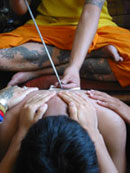
There are many tattooed men. Tattoos are often religious passages or religious symbols that offer protection to the wearer. The more superstitious the person, the more091000k2.jpg tattoos they are apt to have. The properties of tattoos are believed to be similar to those of amulets in the sense that they can offer protection from harm and can been seen as attractive. Tattoos have more recently become modern fashion for some of the men and women who wear them.

‘Yan’ is the drawing of religious mystical symbols to protect the area from ghosts and bad spirits. Most automobiles, taxis, and busses are adorned with ‘yan’ and amulets to ensure safe trips. ‘Yan’ is also painted on the doors of houses to keep unwanted and unseen visitors outside.

Antiques are something that foreigners constantly seek out in Thailand. I have discovered that very often, Thai people absolutely do not want to possess objects that belong to a deceased person for fear of having the previous owner’s ghost attached to the object. “Oh! Look at that beautiful desk! It would look wonderful in my living room!” my friend exclaimed at an antique shop to her Thai companion. “I would091000k3.jpg never buy that,” he answered. “I would think of the person who had to work at that desk everyday. I would wonder if they were happy then and if they are happy now.”

Asking around about ghosts provided the stories that follow.

Puthamonton is a town famous for its haunted bamboo grove. This bamboo grove is on the grounds of the Buddha Park so many monks reside and meditate there. Recently a novice monk became possessed by a ghost and was exorcised by other monks. Reports in Thai newspapers make this common knowledge to most people.

Supanburi is the home to a famous Thai country music singer Phum Phuang who died about eight years ago. When the villagers saw her ghost walking around they decided to build a shrine for her. This shrine now draws hundreds of people who try to receive winning lottery numbers from the deceased.

A cup filled with bamboo sticks with numbers written on them is shaken until a lucky stick falls to the ground. As the Thai national lottery occurs on the 1st and 16th of every month, this shrine is quite active in the days before the drawing. Pictures of this event were recently on the front page of a local Thai newspaper.

Fortune-tellers, mediums, and psychics get a lot of business in Thailand. They are not only consulted for winning lottery numbers, but also auspicious dates on which to conduct an event, or for advice in general life and love decisions.

A young couple who lived north of Ayutthaya recently committed suicide by hanging themselves. The woman was six months pregnant. A letter from the wife requested that the couple be cremated together. When the family tried to arrange this, two local temples refused to do so. Everyone was terrified that the couple would rise from the dead. They feared it was the ghost of Naan Naak returning again. A surgeon was called in and the baby was removed from the mother before the cremation could take place.

Naan Naak is perhaps the most famous of Thai ghosts. We will meet Naan Naak next week, hopefully just in written form.