Archive for March, 2002

How Is Your Heart?

Monday, March 25th, 2002

If you listen to Thai conversations, there are two words that pop up frequently. The first is ‘gin,’ which means to eat or drink as most Thais like to chat about what they ate, what they will eat next, or what they could have eaten but chose not to eat. The second most frequently heard word is ‘jai,’ which means heart. Thais talk about their hearts more than any other part of the body. The state of someone’s heart (not head) is a direct reflection on his or her general well being. If you get a chance to listen to Thai pop on the radio, ‘jai’ (heart) will be mentioned most every song.

One of the first things a child will be taught is the practice of ‘kreng jai.’ ‘Kreng jai’ in a loose translation means ‘respectful to the heart.’ To be ‘kreng jai’ means to be considerate, unassuming and polite, especially to those of a higher social status. The Thai tendency not to rock the boat and keep things harmonious illustrates itself through ‘kreng jai.’

‘Kreng jai’ can express itself in some ways that can be tricky for a westerner to understand. If you offer a Thai friend a drink, they very often refuse it for the first few times. They are being ‘kreng jai’ and do not want to appear selfish or imposing, but will eventually accept the drink. ‘Kreng jai’ is expressed when one eats more rice and less meat during meals. By not asking for things and politely refusing things when they are offered, one is being ‘kreng jai.’

‘Hen jai’ means ’see heart’ or to show sympathy. By sending an employee home early when they are sick, a boss is showing that he ‘hen jai’ his staff. Seeing a problem, recognizing it and trying to fix it are all part of ‘hen jai.’ So is accepting someone’s apology, forgiving an error or offering to assist someone in need of help.

‘Nam jai’ means ‘water heart’ or to act in a kind and generous manner. Thai people place a lot of value on having ‘nam jai’ and by sharing your food, bringing gifts of appreciation or offering to walk someone home, you are expressing ‘nam jai.’ Offering something without expecting anything for it in return is part of ‘nam jai.’

‘Jai dum’ or ‘heart black’ is perhaps the easiest of heart expressions to understand. A black heart means a lack of humanity is being shown. If one is forced to work on Saturday and Sunday for four months, the boss is certainly ‘jai dum.’ When compromises are ignored, feelings are not taken into consideration, selfish decisions are made, these are all signs that a person is ‘jai dum.’

‘Chuen jai’ or ‘joyful heart’ comes from feeling happy or refreshed. Receiving a gift, having your favourite snack offered to you, or enjoying a movie all qualify as ‘chuen jai.’ How to give someone a joyful heart depends on that individual. One person may feel ‘chuen jai’ when out dancing while another may feel ‘chuen jai’ when they receive flowers. Also, on a hot day, a cool, refreshing drink can make you feel ‘chuen jai,’ or refreshed. ‘Thuuk jai’ means ‘compatible heart’ or ‘compatible with your heart’. If someone gives you a gift and you absolutely love it, then that gift is ‘thuuk jai.’ You can also say that you are ‘thuuk jai’ towards the giver for choosing such a fitting gift. ‘Thuuk jai’ means that someone understands your heart and by doing so makes you feel very happy and pleased.

‘Khat jai’ or ‘blocked heart’ comes from feeling displeasure. If someone is not acting generously, considerately, or sympathetically they are ‘khat jai.’ Having a blocked heart means that good things cannot flow from it. When one is ‘ow jai’ or ‘considerate heart’ this means that they are pleased.

‘Jai yen’ means ‘heart cool’ and comes from keeping calm and not showing anger, otherwise known as ‘jai ron’ or ‘heart hot.’ A sure way to lose everyone’s respect in Thailand is by losing your cool. In the face of adversity and frustration, one should remain calm, cool and collected. (See back issues, 02 April 2001 http://www.bangkokpost.net/kat/archives/020401a.html)

Showing consideration of others is the key to expressing your good heart while keeping other people’s hearts happy. Being ’sabai jai’ or ‘happy heart’ is the most important thing in life. If someone is working at a job they do not like and his or her heart is not happy, be sure that they are certain to leave even if the job pays well.

A happy heart is more important than money in the bank or a nice vacation. At the end of the day, Thais judge the quality of their life by the status of their hearts. In Thailand, the status of your heart in other people’s eyes will determine the amount of love, respect, cooperation and friendship you receive.

Parks

Monday, March 11th, 2002

The City of Angels hosts some incredibly peaceful parks. Their serenity becomes even more emphasized by the chaos and noise existing outside of their perimeters. Until this year it never even crossed my mind to go hang out in a park other than my local one, but after a few nice afternoons exploring Bangkok’s parks, I must say I have become quite hooked on them. Parks make you forget about Bangkok for a while. Perhaps the hardest part is exiting them and reentering reality.

The most interesting feature of Bangkok’s parks is that if one were to ignore the greenery, he or she could become convinced that they were sitting in an international airport terminal. Members of almost every nationality go passing by. A good way to pass the time is to try to figure out what language fellow strollers are speaking.

For those interested in bird watching, you may be surprised that the need to go driving off into Thailand’s countryside with binoculars is not as necessary as you may110302k1.jpg think. The “tweet! tweet! tweet!” of feathered friends competes with the sound of planes passing overhead at times. If I were a bird stuck in downtown Bangkok, the first thing I would do is flap my way to a park, too.

Parks are also a good place to observe the mating rituals of teenagers. What better place to run off for some snuggling! Actually, after spending an afternoon observing young love in action, the author discovered that smitten females often choose popping their mate’s acne as a way to express affection. Hmmm.

Other park activities generally consist of napping, reading a book or newspaper, skateboarding and snacking. Sporting events such as jogging, volleyball, rollerblading and Tai Chi come to life in late afternoon. Fast-paced games of ‘takraw’, where a round wicker ball is kicked or head-butted over a volleyball net, is another sure thing. Stick around long enough, and group aerobics class is sure to arrive. Seeing all of the exercise going on can110302k2.jpg make me feel quite sloth-like, having given up the stuff as a birthday present to myself one year ago.

Many large city parks have small ponds. You can rent a boat or canoe and paddle around. For the less active, fish feeding or watching hundreds of children at play is another entertainment option. So is eating. What would a park be without hundreds of food vendors on hand to offer whatever kind of snack you could possibly be hankering for? And unlike in many other countries, cold beer can also be found for sale on the premises. If not, it is no problem if you bring in a few of your own.

Even in the quiet and remote parts of Bangkok, if you stroll around long enough, you are sure to find a park, but you don’t have to be a great city to host a park or two. Even the smallest of Thailand’s towns finds it necessary to have a park. Out in the middle of downtown nowhere, the city landscape often goes like this: small supermarket, market, restaurant, noodle stall,110302k3.jpg hardware store, petrol station, hotel, bank, post office, clothing stall, PARK! Sometimes they may only be five by five metres in total, but the city council is more than proud to have one. A great game to play if you have visitors and are in a town boasting a miniscule park, is to ask with a serious face, “Want to go for a walk in the park?” Proceed to bring them strolling through that small piece of semi-fenced in grass with a bench sitting in it and then say, “Well, that was it!”

And now to let you all in on a little secret. With alcohol venues being forced to close by 2 a.m. now, parks are becoming late night party spots. I had no idea about this until I was out way too late a few months ago with some friends visiting from America. We stumbled into a Thai park-bash in full swing. A singing competition was soon underway with Thai songs definitely winning the gold-medal and the American team making the locals wish they had brought along earplugs.

The party eventually moved to someone’s home. A stereo blasting Laotian music magically arrived on the porch and the author was lucky enough to participate in several free ‘ramwong’ (country dancing) lessons until she eventually ended up breaking her toe. I blame it entirely on my teacher: a man wearing an electric blue shirt with bright yellow bananas all over it. I was so distracted by the shirt that I could not keep track of my feet. My advice: no matter where you are in Thailand, track down the local park and sit in it for a while. You never know what will happen.

Tattoos and Trances

Monday, March 4th, 2002

What could make the author hop out of bed at 5 a.m. on a Saturday? The annual tattoo festival at Wat Bang Phra in the town of Nakhorn Chaisri, of course. Arriving at the temple by 7 a.m. with bags under my eyes was more than worth the 25-kilometer journey out of Bangkok. Wat Bang Phra is home to Luang Phor Pern, a venerated monk famous for his tattoo art along with other resident monks skilled with the needle (or in this case, metal rod).

These tattoos are said to protect wearers from injury or harm and possess magic qualities. Individuals sporting these tattoos often have dangerous professions such as high-rise construction, law enforcement or gang activity. Most of the men in the crowd had their shirts off revealing entire torsos, backs and arms filled with sacred Buddhist texts, numerology charts, mythical creatures and animal motifs. Inkless scarification works were also seen. Luang Phor Pern’s followers had come to his temple on February 23rd, 2002 to spend the morning040302k1.jpg letting the spirit and magic of their tattoos take over their bodies.

Even though it was very early, hundreds of people were already sitting on the ground facing a large stage where statues of the Lord Buddha had been placed. Monks and laypeople were making religious offerings of lotus buds, incense and candles. Many members of the audience sat meditating and chanting. Occasionally the roar of a lion or the squeal of a monkey could be heard rising up from the crowd.

Those individuals sporting tiger tattoos were overtaken by its spirit and charged and growled towards the stage with claws out. Others with snake tattoos crawled and squirmed on the ground. People sporting bird tattoos soared through the crowd with wings spread while those with monkey tattoos stomped and jumped around. Those sporting tattoos of an ascetic mountain dwelling monk orchestrated the quietest and slowest moving of all trances.

Every few seconds a member of the crowd would040302k2.jpg either start breathing heavily or yelling animal sounds and then run, jump, hurl, crawl, stumble, walk or charge towards the stage. A large line of soldiers and civilians were lined up to catch and restrain and calm down the often-frenzied participants. A crowd of international journalists gathered in the front rows and thousands of pictures were snapped. By afternoon over 7,000 people were in attendance.

Some individuals fell under trance over six times. A young boy about the age of ten fell under the tiger’s spell and four women were taken over by the spirits corresponding to their tattoos. By early morning there were up to 35 individuals charging blindly through seated onlookers. Some trance participants seemed to fall totally under the spell and generated sounds and seizures that would be more than difficult to create under normal states of mind. At other times it became questionable as to whether participants were truly under a trance or just using trance as an excuse040302k3.jpg to charge with flailing fists into a crowd of soldiers and not get into trouble.

When the venerated Luang Phor Pern took the stage to spray holy water and give blessings, the number of individuals in trance intensified, screams went up, and other members of the audience swarmed to the stage causing a minor stampede effect.

In late morning the crowd started dispersing. The monks went to eat their last meal of the day. Some returned later to sit under the shade of trees and re-bless tattoos. Crowds of men gathered around to have their heads touched and then blown on and their backs patted on three times as part of the re-blessing ceremony.

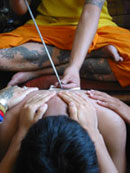
The monks then proceeded into a small temple building where scores of people had lined up to receive new tattoos. The air was heavy and dark with incense and the room was silent. The monks sat at the front of the room and Luang Phor Pern held a long metal rod, which was first dipped in black ink and then jabbed in quick burst into the back of the person leaning in front of him. Short metal needles were used for scarification tattooing. The tattoos were completed with amazing speed and artistry. The only sterilisation that took place between each tattooing sessions was a quick dip of the metal tools into bowls of antiseptic.

As someone who is not only interested in tattoos but sports a few herself (much to Mom’s dismay), the tattoo festival at Wat Bang Phra was one of the most fascinating events I have attended in Thailand. The day provided insight into an occult-like subculture within Thailand and also allowed a lot of close up viewing of amazing ink work. Whether or not the tattoos and trances of Wat Bang Phra are magic is for each individual to decide, but the visual spectacle of the event makes it a worthwhile way to spend a very early morning.